
Best Compact Cameras: Canon G7 X III vs Sony ZV-1 II vs Panasonic LX100 II
By Alex Thompson · July 27, 2025 · 6 min read
This page contains affiliate links. If you buy through them, we may earn a commission at no extra cost to you. As an Amazon Associate I earn from qualifying purchases. Learn more · How we compare
All three take a large sensor and a bright zoom into a jacket pocket, and that is where the similarity ends. One is built around a microphone jack and a screen that flips up at you, one around the widest lens of the three, and one around a viewfinder and dials on the body. Pick by how you shoot, not by the sensor size.
Which One Should You Get?
- Best for streaming and talking to camera – Canon PowerShot G7 X Mark III – the one built for vlogs: a screen that flips up, a microphone jack and streaming straight to YouTube.
- Best for handheld shots at arm's length – Sony ZV-1 II – the widest lens here, which is what you notice the moment you hold the camera out in front of you.
- Best for photographers who want dials – Panasonic Lumix LX100 II – the only one here with a viewfinder and a sensor bigger than an inch, and the only one without a microphone jack.
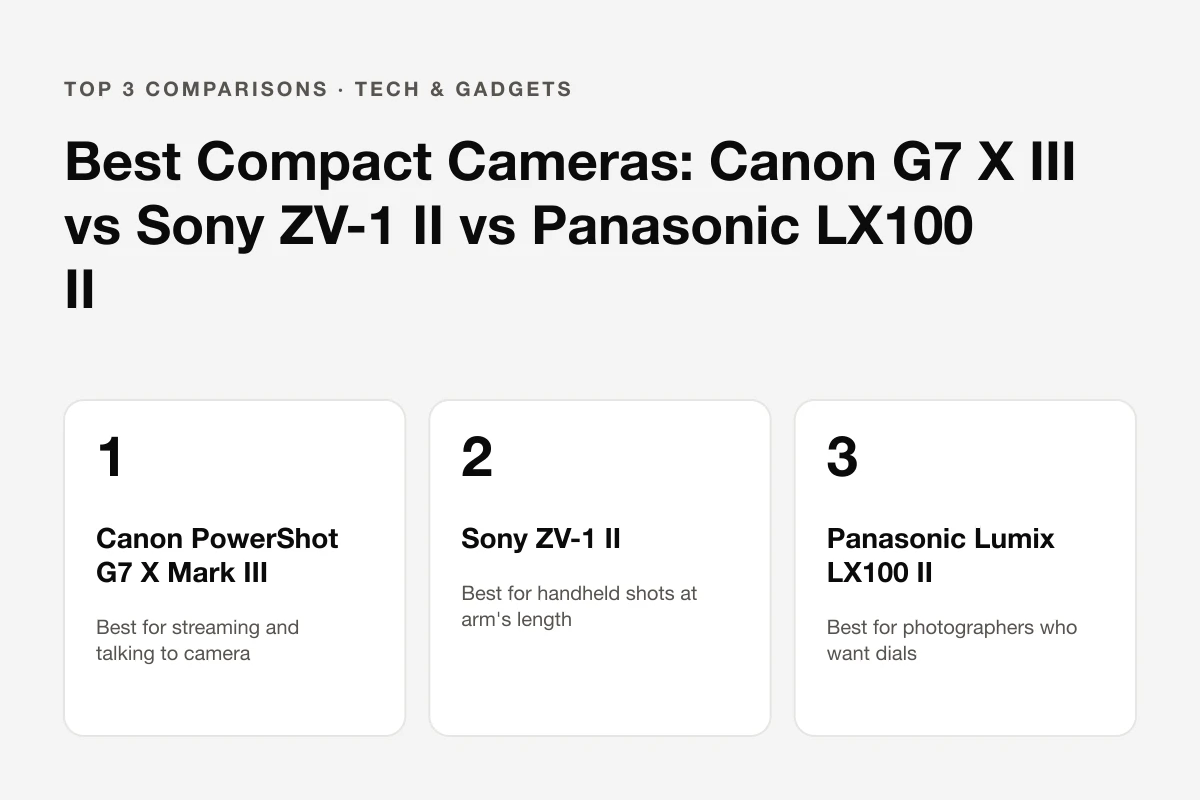
Canon PowerShot G7 X Mark III, Sony ZV-1 II and Panasonic Lumix LX100 II
Pros
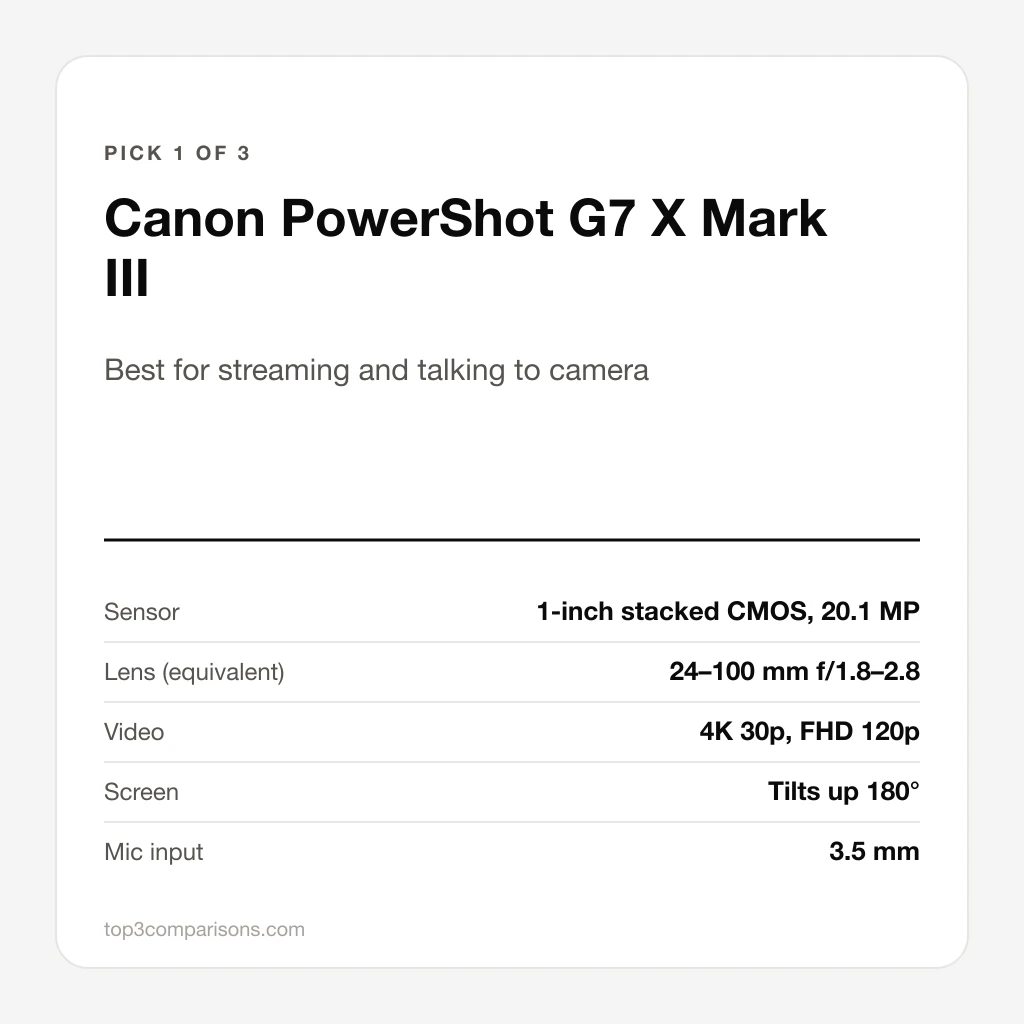
- Live streaming to YouTube from the camera itself
- 3.5 mm microphone input, which the Mark II lacked
- 4K 30p taken from the full width of the sensor
- Longest reach of the three at 100 mm equivalent
- Burst shooting up to 30 frames per second
Cons
- No viewfinder, so bright sun means guessing at the screen
- The screen tilts up but does not flip out to the side
- The oldest design of the three
Unique Features & Insights
Pros
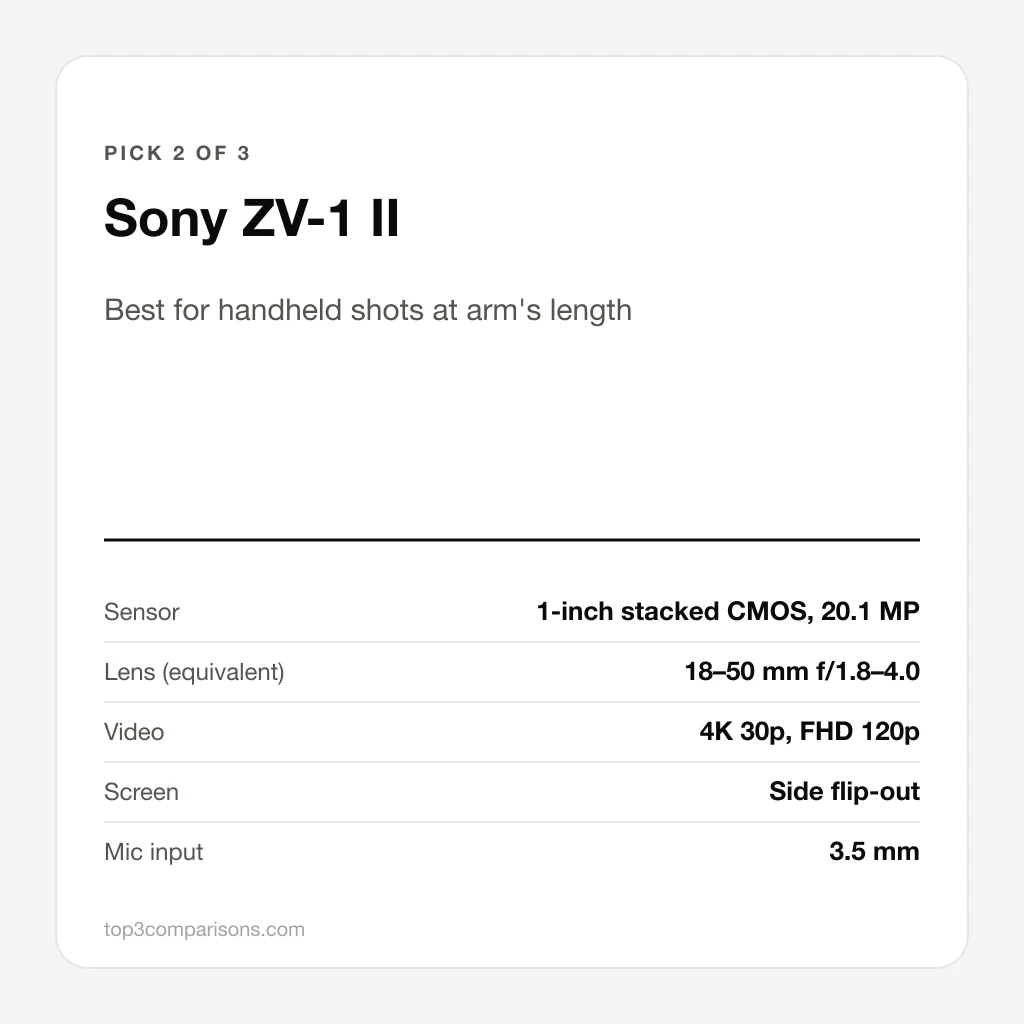
- Widest lens of the three at 18 mm equivalent
- Screen flips out to the side, clear of a microphone or cable
- Three-capsule directional microphone built in
- 3.5 mm microphone input
Cons
- The lens slows to f/4.0 at the long end
- No viewfinder
- Shorter reach than the Canon
Unique Features & Insights
Pros
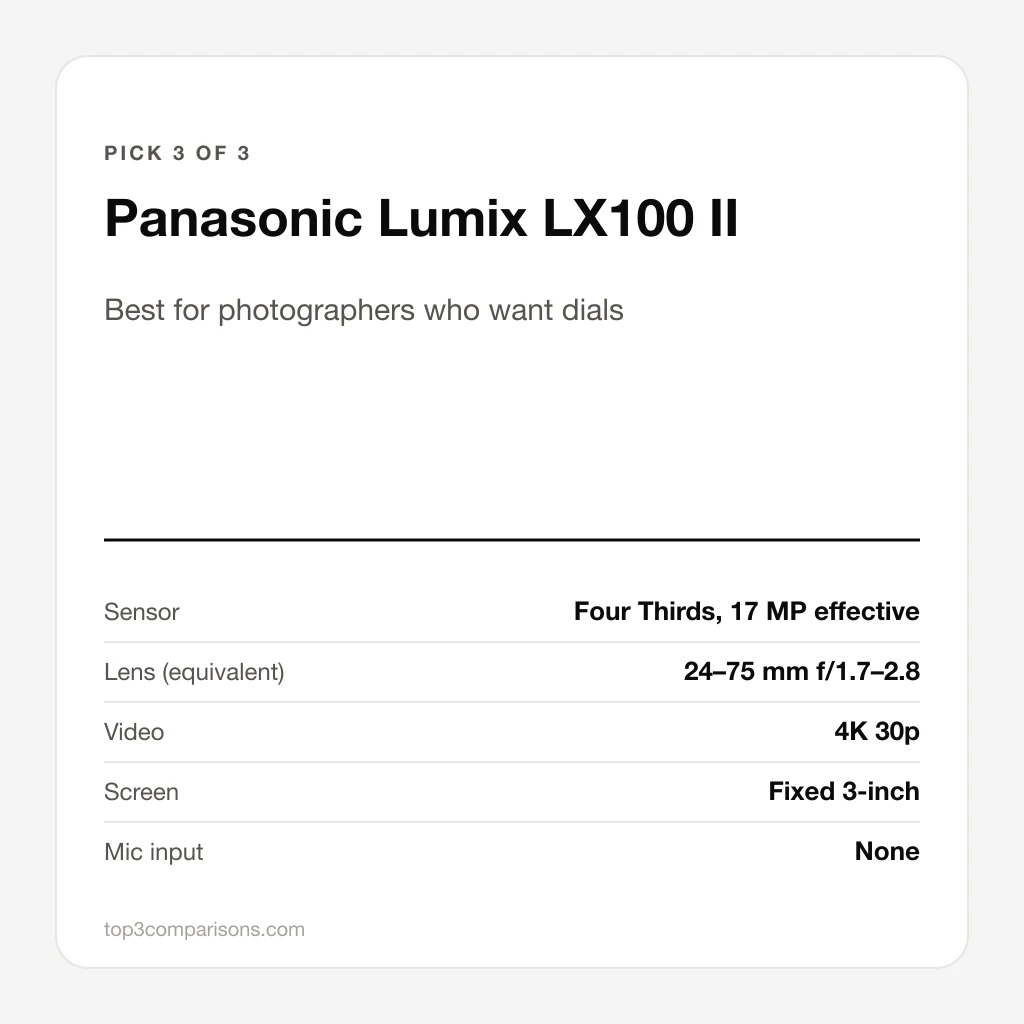
- Four Thirds sensor, larger than the other two
- Electronic viewfinder that wakes on eye detection
- Aperture ring and shutter dial on the body
- Brightest lens of the three at f/1.7
Cons
- No microphone input at all
- Fixed screen, so it cannot face you
- The oldest model of the three
Unique Features & Insights
Final Comparison Table
If most of what you shoot is you, talking, the Canon and the Sony are the two to choose between, and the deciding factor is whether you want reach or width. If you mostly shoot stills and want a camera that handles like a camera, the Panasonic is the one, as long as you can live without a microphone input. Check current availability through the links above.
Frequently Asked Questions
Which of these can take an external microphone?
The Canon G7 X Mark III and the Sony ZV-1 II both have a 3.5 mm microphone input. The Panasonic LX100 II does not have one at all, so its audio is whatever the built-in microphones capture.
Which has the widest lens for handheld vlogging?
The Sony ZV-1 II starts at 18 mm equivalent, wider than the Canon's 24 mm and the Panasonic's 24 mm. Held at arm's length that is the difference between your head filling the frame and the room being visible behind you.
Do any of them have a viewfinder?
Only the Panasonic LX100 II. Its electronic viewfinder is quoted at 2760k dots and switches on when you raise the camera to your eye. The Canon and the Sony are screen-only.
Which is best for photos rather than video?
The Panasonic. Its Four Thirds sensor is larger than the 1-inch sensors in the other two, it has aperture and shutter dials on the body, and the viewfinder makes it usable in bright sun.
Can I use them as a webcam or for live streaming?
The Canon G7 X Mark III supports live streaming to YouTube directly from the camera, which is the feature it was built around. The other two work as webcams through a computer and the right software or capture device.
Is 4K worth it on cameras this small?
All three record 4K at 30p, and the Canon and Sony also offer 1080p at 120p for slow motion. On a phone-sized sensor 4K mostly buys you cropping room in editing rather than visibly sharper footage.
We gather insights from Amazon reviews, Reddit discussions, YouTube demos, and expert blogs. Buying through our affiliate links costs you nothing extra—it simply supports the research behind these reviews.
New comparisons, straight to your inbox
Get a short email when we publish a new product comparison. No daily noise.
Related Posts
Best Tablets with Stylus in 2025: Apple iPad Air vs Samsung Galaxy Tab S9 vs Tab S9+ Compared
Compare three top-rated tablets with stylus support—Apple iPad Air (M1), Samsung Galaxy Tab S9, and Samsung Galaxy Tab S9+—and discover which is best for students, creatives, and professionals.
Best Laptop Backpacks in 2025: Top 3 Compared
Compare three of the most popular laptop backpacks of 2025 — The North Face Borealis, JanSport Big Student and Razer Rogue V3 16″ — to help you choose the right carry for class, commuting or gaming.

Best Travel Backpacks for Women: MATEIN vs Travelpro vs Osprey Fairview
A 19-liter under-seat pack, a 40-liter budget carry-on with a shoe compartment and a 40-liter women's-fit pack with an adjustable torso are compared on size, laptop fit and weight.